
The first time it's random.
The second time it's purposeful.
The third time it's expected.
This progression informs how we build collaboratively in improv, be it in service of a pattern of emotional behavior, a relationship dynamic, a group game, or forging an organic format.
What is necessary to elevate a random occurence into a shared experience? It requires that second move - the choice to make the first move matter.
Derek Sivers gets it.
"It Takes Two."
Want to build an organic format with your team? Commit to repeating stuff. Then, once repeated, commit to repeating it again.
What stuff? All of it. Characters, scenes, conventions, themes, language, locations, accents, objects, reactions,...all of it.
To illustrate, let's walk through Horse Apples' 8/6/16 show -
And now we just to playing with the established information.
There was a lot of information in the first two scenes. The choices made in the 3rd and 4th scenes help set for the team which information they'll focus on: the umbrellas, the tiers of heaven, the integration of new technology and the dinner with the preacher scene. It's an amazing moment as an improviser to feel "we got this." That feeling happens when a teammate purposefully revisits something that was random the first time, because everyone expects that something to be revisited again. The moment when David brings the show back to the preacher dinner scene but sits in a different seat to designate playing a different role, all three players know, "oh, yeah, we'll be doing this scene again." And they did.
Before the show, we talked about wanting to make up a format. We talked about how we could use standard edits, like the scene painting move wherein you take an object from one scene and transition in into another (ex: "The loose kite darts away in the wind, dancing high enough for it to be glimpsed by a young boy in an airplane..."). We talked about using Transformations. We talked about Dual Casting. But in the end we didn't want to force any particular move. We wanted whatever we did to be Organic.
In retrospect we could define our form. We could call it "The Up, Down and Across" for how we explored heirarchies and connected ideas. But we didn't find it because we mapped out ahead of time how we would transistion between scenes and heighten beats. We found our form by choosing to repeat choices and committing to again repeating what we chose.
The first set of scenes were random. The second set was purposeful. And the final series were expected. But, please note, those final scenes were not rigid or cliched. We knew what we were playing with in those scenes; and when you know what you're playing with then you can really PLAY.
.
So Let's Play!
Here's an exercise to help us set and cement patterns that can facilitate organic format creation.
CARTOON BASED BUILDING - Prepare for the exercise by finding comic strips you can cut out. Sitting around in a circle, pass out the prepared stack of cartoons to the ensemble; they can pick their favorite. Using their chosen comic strip as the first scene, their job is to come up with the second idea based on the cartoon. Each cartoon is bound to have several different aspects to it: type of characters, age of characters, location of characters, relationship between characters, conventions of language and interaction, and of course the joke. From the myriad options, the improviser can choose any to base his/her second scene on. One at a time around the circle, an improviser reads his/her chosen comic strip (as though sharing it with a kindergarten class) and then shares his/her idea for the second scene. Then a different improviser - it doesn't have to be anyone in particular - shares an idea for a third scene based on the established progression. Repeat.
As an example, take this Family Circus from Bil and Jeff Keane: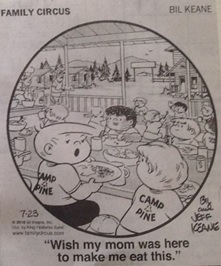
Typical of this legendary cartoon, there's a lot at play here. Camp. Unappetizing food. Kids needing parents to make them do the right thing. So the lead improviser has a slew of options.
Option 1 Second Scene: A bunch of bros at a bar lamenting how their girlfriends aren't around to keep them from getting drunk.
Option 1 Third Scene: A bunch of old men sitting on a porch crying over how if their wives were alive they wouldn't be yelling at passers-by.
Option 2 Second Scene: Other camp kids running with scissors around the craft area.
Option 2 Third Scene: Still other camp kids adrift in a canoe without supervision.
Option 3 Second Scene: The teenage staff at camp drinking smuggled in beers.
Option 3 Third Scene: The parents doing drugs since their kids are at camp.
The scenes don't even need to heighten "the game" of the comic strip; they can just expand the world. Campers, to Staffers, to Parents would suffice. The key is making a choice of what to repeat from the comic strip and then committing to repeating what was repeated.
Importantly, the subsequent scenes are self contained. If we went the route of the Parents of Campers, the parents are not going to talk about how they expect their kids to be eating healthy in their absence. While they might reference the fact that their kids are away, allowing them to do drugs, they are going to be engaging with the drugs way more than they'll be talking about their kids.
Here's another example from Frank & Ernest by Thaves:
If the Second Scene is set in modern times, say an Ironic Hipster with a music-playing tie, where does the Third Scene take place? I'd say "the future," but really anywhere but back in Medievel times as we're looking to follow the established progression.
If the Second Scene is based around a Medievel lute player, well then, so should the Third Scene be set in Medievel times. Maybe a peasant is popping his plague boils in rhythm.
But, again, we don't have to adhere so hard here to heightening the joke. Knight, to Lute Player, to Peasant, without any focus on the music would suffice.
.
So Let's Put It Up On Its Feet!
It's one thing to come up with a Second Scene after you've been given time with the base material. It's similarly easier to come up with a Third Scene when the onus is shared by all the improvisers and it can be discovered through discussion. The pressure to satisfy a progression is harder in the moment of a show. As a result, players can miss editing a scene when they should because they're in their heads thinking of the "right" next thing. We want to reduce that pressure.
ORGANIC PROGRESSION SETTING - Two players on stage. The rest of the ensemble are in ready-positions for executing edits. The first two players on stage are charged with just doing a scene - any old scene. The players on the wings are charged with watching that scene to identify what - from amongst the many options - they want to repeat when they initiate the Second Scene. Those players not in the Second Scene are thereby charged with thinking up a way to repeat through their Third Scene what was repeated in the Second Scene.
What if the First Scene involves kids in a clubhouse accessed with a password and imagined into a pirates' ship...
Second Scenes could follow:

Third Scenes could in turn follow:
You've watched the First Scene from the wings. Then you see the Second Scene use Pirates. You're on the wings thinking, "How do I heighten the progression from kids to pirates?" And you're thinking so long you miss the edit. We don't want that.
In forging an organic format, following the pattern progression is less important than making that second choice to repeat. If there's no clear move on the progression, just repeat. Repeat kids playing. Repeat pirates. Be kid pirates playing. Be pirates forgetting passwords. Be anything as long as you're repeating something. By repeating we draw focus on material that can then be the spine of our organic format. That organic spine need not be straight; there needn't be a progression of scenes. We just want to base our subsequent scenes on established material by repeating something.
.
Whatever you do, do some part of it again. Once you've repeated something, look for an opportunity to repeat it again.
The second step is your first step in forging an organic format.
[…] the Set dialogue – as Set moves should – clearly established a progression of antiquated occupations. It’s super helpful that […]
[…] If this Weakness is identified, the following posts may prove helpful in coaching to the Opportunity: * Kick The Duck Red Rover * Flexible Long Form “Formats” * Establishing Organic Forms […]
[…] Forging An Organic Format: Part Two […]
[…] “World Building” is a noble pursuit in long form improvisation. It can focus our creativity to try to link our scenes to a single location, time or conceit. The Chicago-based People of Earth, for example, placed all of their scenes on the same train. Horse Apples set an entire long-form in a future where everyone had bionic limbs. The audience adores this organic world building. […]
[…] Build a movement. Follow and heighten. […]
[…] Some looked to map a relationship from earlier in the set onto a different world. Some liked following the theme implied by a certain line of dialogue, by juxtaposed details or status. And the realization was […]
[…] Dual Casting became the spine of the organic format we forged…in addition to grandparents, in came the pool boy and his mother, the mailman, a bear and the […]