
The key to sustainable, dynamic two person scenes that are most conducive to improv as improv does best is setting up patterns of emotional behavior. While in the Facebook age, the world defines their friends by who, what, where and when, we know we know a person when we can say, “That’s how he is.” It is through how our characters interact with their world – other characters, objects, actions – that the audience comes to know them. Knowing how our fellow players’ characters will react enables us to play to them, to set them up. Setting up and leveraging patterns of emotional behavior equips us to establish and evolve expectations to engage and surprise the audience.
Without patterns of emotional behavior, improvisers explain more than they exhibit, they act erratically if they act at all, and they disengage an audience that gives up caring about flat or scatter-shot scenes.
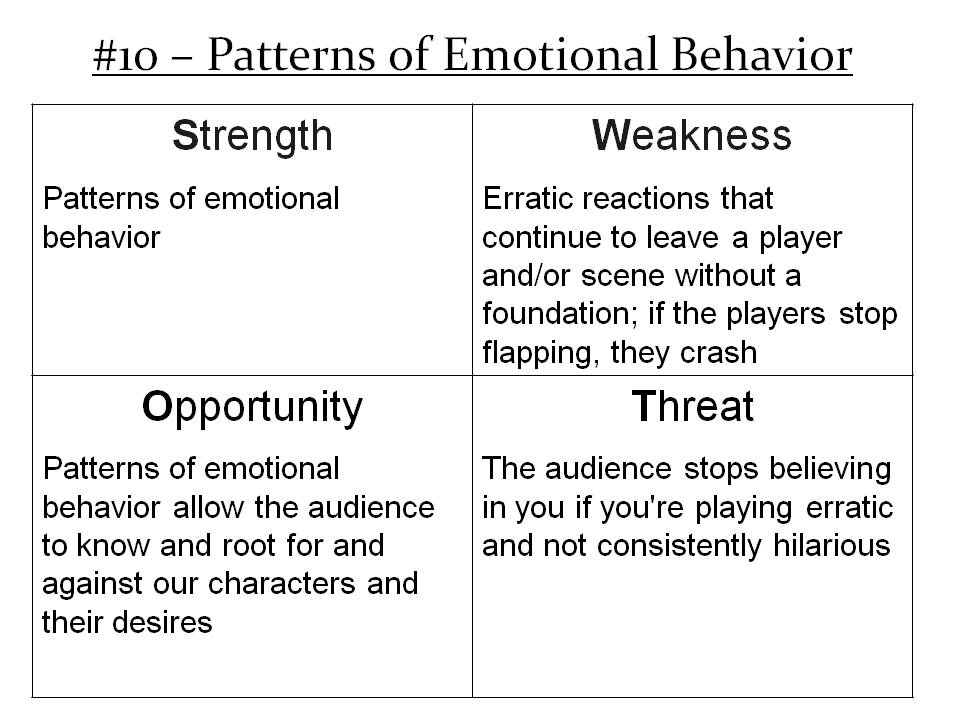
If this Weakness is identified, the following posts may prove helpful in coaching to the Opportunity:
* Scene Trajectories
* Establishing Triggers
* Sustainable Scenes
* Behavioral Stakes Exercises
* How, not who, what, when, or where
[…] and vulnerable to the moment? Too often we’re too focused on our impression to set up the patterns of emotional behavior triggered by active elements that are the core of Improv As Improv Does […]
[…] Snatching’s fun lies in not only the heightening of emotional behaviors that underlines improv as improv does best, but in one player’s heightening of another […]
[…] we’ve heightened a series of reactions. You’ve served Player Two by setting up her pattern of emotional behavior. The audience knows her, knows she’s excited by protection. Knowing her, they’ll reward […]
[…] Patterns of Emotional Behavior - Player acts randomly and reacts erratically […]
[…] Patterns of Emotional Behavior - Player acts randomly and reacts erratically […]
[...] pursuing improv as improv does best, we seek to establish patterns of emotional behavior, leveraging them in developing sustainable scenes and subsequent [...]